
-
Effective Removal of Cement Residue on Finished Surfaces
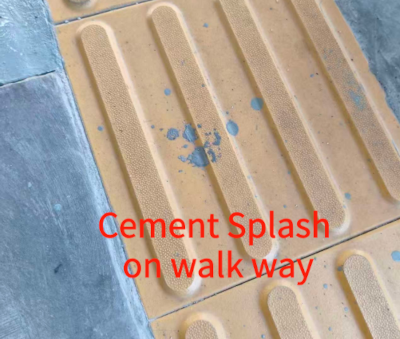
Cement Residue on Walkway Cement residue removal is a common challenge faced during post-construction cleaning. After construction work is completed, small cement splashes can often be found on finished surfaces such as tiles, pavements, and walkways.
Even though fresh cement splashes can be removed easily, aged and hardened cement residue becomes difficult to clean once it bonds to the surface. EC Clean has developed an effective cleaner for removing cement residue without damaging the substrate surface.
Use EC Clean Splash Remover solution to clean up the residue effectively.
Why Cement Residue Becomes Hard to Remove?
Cement is the binding agent used in construction. It binds stone-based materials together to form a solid structure. Newly mixed cement with water and sand forms mortar, which is initially soft and workable. Over time, the water content in the mortar gradually evaporates and the cement begins to harden.
As the mortar hardens, it becomes extremely strong and also adheres firmly to adjacent surface. When cement splashes are left on tile surfaces, they harden through dehydration and bonding, making them difficult to remove.
Because of this strong bonding characteristic, cement residue removal becomes challenging if the proper method is not adopted. For example, using a scraper alone may not be effective for removing cement splashes completely. In some cases, it may even cause scratches on the tile surface.
Effective Method for Cement Residue Removal
For cement residue removal, the best approach is to use a specialized cement cleaner such as Cement Splash Remover from EC Clean. We have come across many cleaners in the market, but unfortunately most of them are not effective for this purpose.
There are several important considerations when selecting an effective cement cleaner:
- Specialized cement cleaner formulation
- Chemical reaction between the cleaner and cement residue
- Effective chemical breakdown mechanism
- Minimum mechanical scraping required
- Ability to maintain substrate surface integrity
How a Professional Cement Cleaner Works?
To effectively clean cement residue, a combination of chemical and mechanical mechanisms is required during the cleaning process. In most cases, the chemical effect plays the dominant role.
Chemical Effect in Cement Cleaning
For the chemical process, the cleaner must initiate a reaction that breaks down the cement residue. By looking at the cement composition, the primary content is calcium-based material, acid can be used to react with the cement. Below is the simplify reaction between cement and acid reaction.
The reaction can be simplified as:
Calcium Oxide + Acid → Calcium Salt + Water
During this reaction, the calcium component is consumed and dissolved. This helps loosen the cement residue from the surface.
Mechanical Effect
Even though the calcium oxide is dissolved during the chemical reaction, mechanical action is still required to remove the resulting calcium salts from the surface. This is where surfactants play an important role.
Several mechanical actions occur during the cleaning process:
- Surfactants help lift contaminants from the substrate surface
- Dispersing agents prevent calcium salts from re-adhering to the surface
- Gentle brushing on the cement residue area promotes effective cleaning
We have discussed the key principles for effectively cleaning cement residue from finished surfaces. For more information about professional cement residue removal, feel free to contact EC Clean or learn more about our Cement Splash Remover.


Buy at Our Lazada Store